Jan 16, 2026 in Research
Crypto in 2026: From Narratives to Infrastructure
Author: Aryan Sheikhalian
Crypto has entered a different phase of its development. The dominant question is no longer whether the technology works, but where it delivers structural advantages over existing systems. After more than a decade of experimentation, the industry is moving beyond narratives centered on disruption and toward measurable improvements in capital efficiency, settlement, and risk management.
From CMT Digital’s perspective, 2026 represents an inflection point where crypto increasingly competes with legacy financial infrastructure on function rather than ideology. The predictions that follow are grounded in how incentives are shifting across markets, balance sheets, and institutions. They reflect areas where we believe onchain systems begin to quietly replace incumbent processes, not through sudden adoption, but through steady economic pressure.
The Death of the Four-Year Cycle and Declining BTC Volatility
Bitcoin is finally breaking its historic boom and bust cycle. In 2026 we will look back at the halving-driven four-year pattern as a relic of a less mature era. The structural forces that once drove this cycle are significantly weaker. Each halving now represents a diminishing mechanical supply shock, with the block reward reduced to just 3.125 BTC and soon lower.
At the same time, institutional demand through ETFs, corporate treasuries, and pension funds, and long-duration allocators increasingly absorb more than the entirety of new daily issuance. Bitcoin is transitioning from a retail-driven speculative asset into a long-term macro allocation. Market direction is now dictated less by the halving calendar and more by global liquidity conditions, real rates, and risk appetite.
This transition does not eliminate drawdowns or reflexivity, but it could materially reduce volatility. By 2025, Bitcoin’s realized volatility had already fallen below that of NVIDIA stock. Lower volatility widens the design space: treasury desks can model exposure, lenders can underwrite risk, and Bitcoin therefore can be treated as viable collateral across institutional balance sheets. Bitcoin increasingly behaves not like a trade, but like infrastructure.
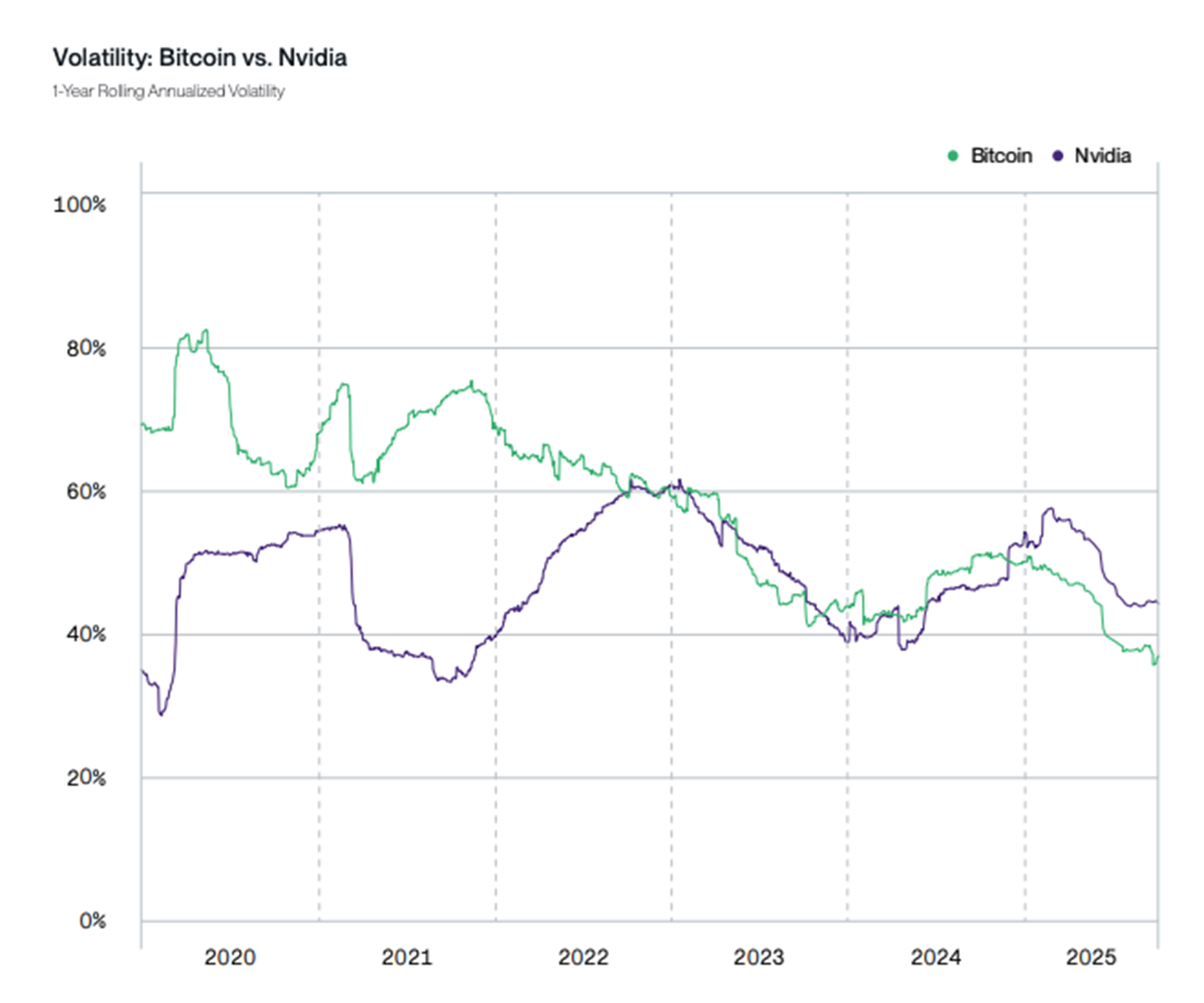
Figure 1. Source: Bitwise
Stablecoins Become the Settlement Layer of the Dollar
We believe the stablecoin market cap will breeze past 500 billion in 2026; on a trajectory toward 1 trillion. Crucially, transaction volumes have decoupled from crypto trading and moved into global corporate settlement. This growth is fueled by the dollar superiority thesis, where stablecoins act as a digital export for US monetary policy, allowing global users to bypass failing local banking systems and save in a trusted unit of account.
This dynamic accelerates global re-dollarization through open infrastructure.
One stablecoin prediction for 2026 is the Great Regulated Flip, where onshore dollars aggressively capture the institutional market from offshore giants. The real disruptor will be USAT, Tether’s first U.S. regulated stablecoin. By launching USAT through Anchorage Digital Bank and Cantor Fitzgerald, Tether is pivoting to play by American rules under the GENIUS Act.
We anticipate USAT will successfully bridge the gap between Tether’s massive global liquidity and U.S. regulatory trust. This creates a bifurcated market where USDT remains the dominant offshore engine for emerging markets, while USDC and USAT enter a winner-take-all battle for Wall Street's settlement rails.
Pure fiat-backed stablecoins that pay no interest will become obsolete. While the base tokens remain non-yield bearing, they will be used as the primary collateral for the yield engines.
Tokenization and the Death of the Illiquidity Premium
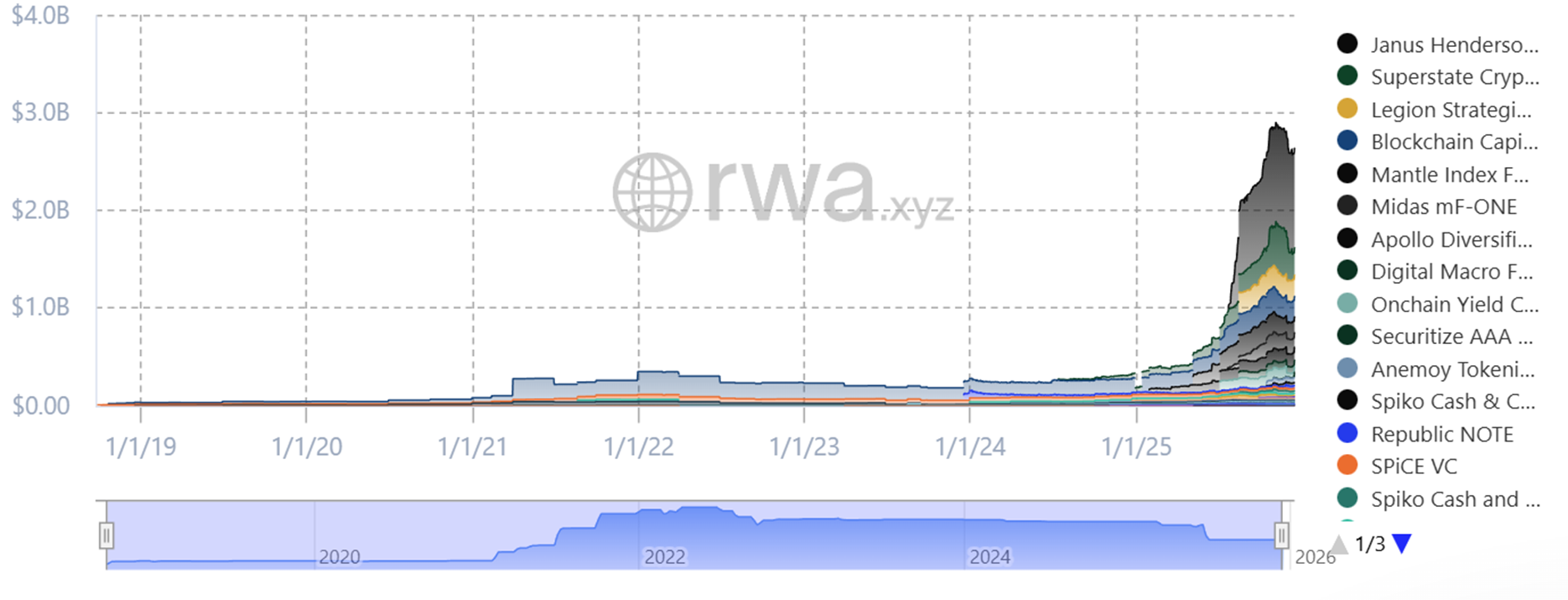
We have written extensively about this topic, most recently HERE. In 2026 we anticipate seeing an expansion in both the scale and variety of RWAs that are available onchain. One of the most important features that RWA tokenization should support is in the breadth of collateral types available. We already see early innings of collateral expansion with the work portfolio company Ethena and Hyperliquid are doing. Treasuries and an increasing range of onchain assets were the first step. The next phase includes an expansion into markets such as private credit, revenue based instruments, structured notes, and long-tail corporate assets.
Portfolio company Superstate highlights this evolution, by building tokenized investment products and connecting traditional financial assets to crypto capital markets through onchain public listings.
We believe that a broader collateral universe is crucial as it changes the design space for onchain finance. Protocols will be able to build systems around asset mixes that were previously inaccessible. Risk can be more finely sliced, tranched, and distributed in a way that is transparent and auditable. Onchain balance sheets start to look closer to traditional credit markets, but with instant settlement and verifiable reserves.
We also believe that tokenization will give rise to a more structural shift: The death of the illiquidity premium. This signals the end of the traditional ten-year lockup model. For decades, Private Equity and Venture Capital have relied on the "illiquidity premium", the idea that investors must be compensated for locking up capital. In 2026, we expect this dynamic to invert. As high-quality assets migrate onchain, the market will begin to demand a "liquidity discount" for any vehicle that prevents exiting positions. We anticipate seeing the first "Liquid Venture Fund" trade at a premium to its Net Asset Value (NAV) on a DEX, purely because of its instant liquidity. Investors will no longer accept artificial lockups when they can access the same underlying risk exposure with 24/7 exit rails.
 Ethereum Upgrades Turn ETH Deflationary and L2s Consolidate
Ethereum’s roadmap prioritizes higher throughput and cheaper data availability and credible neutrality. Mid-2026 upgrades will enable parallel processing and staged gas limit increases toward 200 million per block. Under realistic 2026 blob and usage assumptions, sustained deflation becomes a credible baseline, but not the primary driver of value.
However, the L2 ecosystem is facing great consolidation. While hundreds of venture-backed L2s launched in the past few years, 90% of activity will concentrate on just a few winner-take-all chains like Base. Ethereum’s role is not to win the app layer, but to dominate settlement and data availability.
Ethereum increasingly defends value by maximizing economic throughput, not narrative leadership. It wins by being boring, cheap, and everywhere.
Onchain Vaults to Compete with Banks
Vaults gained traction in 2025 but remained narrow in scope. In 2026 they start to operate as generalized yield engines. They combine tokenized assets, protocol efficiencies, and automation to produce return streams that are not simply beta exposure masked behind complexity.
Portfolio company Axal exemplifies this shift. The product abstracts away gas, onchain routing and protocol selection, and packages institutional-grade DeFi strategies into a mobile-first interface. It integrates sources of yield such as Morpho vaults and runs them under the hood, while users fund with fiat on ramps like ACH and hold positions in smart wallets.
The real breakthrough is non-beta yield: MEV capture, execution optimization, hedging, and structured credit. These vaults become the passive gateway for capital onchain.
The result is a growing set of return sources that investors can allocate to without dealing with operational overhead. These vaults will become the default gateway for passive capital onchain.
The proliferation of these vaults will precipitate a quiet solvency crisis for regional banks. In 2026, the spread between onchain risk-free rates (derived from tokenized Treasuries) and the near-zero interest offered by traditional checking accounts becomes too wide to ignore. "Yield-aware" wallets will automate the sweep of idle cash into onchain vaults, effectively creating a slow-motion bank run. We expect to see deposit flight from small-to-mid-sized banks not to competitors like JPMorgan, but to onchain protocols. This forces a confrontation where legacy institutions must lobby for "wallet regulation", incorporate onchain yield into their product offering, or drastically raise rates to survive, as their cheapest source of funding, sticky, lazy deposits, evaporates.
The Rise of Crypto-Native Banking
The rise of stablecoins forces a reconfiguration of banking itself. Crypto-native banks emerge with real market share not because incumbents are forbidden from holding tokenized assets, but because they lack the operational infrastructure to do so at scale.
Portfolio company Erebor illustrates this shift with a conditional national bank charter and FDIC insurance. It is the first US national bank designed from inception for digital asset intensive treasuries and technology clients. It lends against non-traditional collateral, supports stablecoin heavy treasury management and operates with full federal oversight.
Globally, this matters even more. Roughly 1.4 billion adults remain unbanked. Many have smartphones but no access to formal finance. Crypto-native banks and wallets stand to offer alternative rails for a massive portion of the global population and offer them usable savings, payments, and credit products.
Adoption will not be uniform. In regions with high mobile penetration and strong existing crypto usage such as LATAM and MENA, it is reasonable to expect high single-digit to low double digit percentage penetration of crypto-based accounts among unbanked adults. This adds tens of millions of people to functional financial systems. For many, a crypto wallet or a crypto-native bank account will be the first financial account they ever open.
Perpification of Almost Everything
One of the clearest structural shifts in 2026 is the expansion of perpetual futures into equities, FX, indices and RWAs. Retail already prefers perps because they are simple. You simply pick the asset, choose direction, and choose leverage. For institutions, perps solve the weekend problem. Funds can hedge exposure when CME screens are dark, and retail can trade on a 24-hour cycle. Modern venues now allow this with credible infrastructure, robust price bands and controlled marks.
Hyperliquid, TradeXYZ, and portfolio company Architect have turned this synthetic layer into a real market. Architect in particular offers 24-hour rails for US equities, FX and certain tokenized real-world assets. The result is a global derivatives market that no longer sleeps. The product is simply better than legacy alternatives.
There will be an exuberant phase. Anything with a weak or noisy benchmark will attract traders looking for volatility. Pre-market names, illiquid single names and bespoke synthetic exposures will go through predictable boom and bust cycles. Over time, liquidity will settle around assets with deep and transparent benchmarks such as FX, major indices and large-cap equities. The synthetic layer stays and becomes a permanent part of global market structure.
This accelerates exchange unbundling. As onchain liquidity deepens, the "Super App" model of the centralized exchange begins to break. In 2026, we expect major centralized exchanges (CEXs) to see their trading volumes flatline while onchain volume explodes. Sophisticated users will increasingly treat CEXs as mere fiat on/off-ramps, while executing their actual trades on specialized perp DEXs that offer self-custody and better capital efficiency. To avoid becoming obsolete utilities, major exchanges will be forced to pivot aggressively, launching their own smart wallets and non-custodial interfaces to capture fees from activity that no longer happens on their own order books.
DePIN Becomes CAPEX Arbitrage, Not a Narrative
DePIN transitions from speculation to infrastructure. Portfolio company Helium is one such reference point. It operates a user-deployed wireless network that already reaches over one hundred thousand hotspots across the US and Mexico. Its partnership push into Brazil targets more than one hundred million underconnected users who rely on public or shared WiFi. Helium shows that DePIN can scale when the user does not need to know anything about crypto. They pay for connectivity. The token incentives sit behind the scenes.
DePIN market caps have compressed over the past year, yet the number of DePIN networks has grown from ~300 to 430 and active devices from ~20k to 40k+, signaling that speculative capital is retreating while real adoption accelerates. As networks like Helium Mobile (130k+ users), Render, io.net, Filecoin, and Hivemapper demonstrate, the model now hinges on projects proving sustainable unit economics and delivering services that centralized providers structurally cannot.
This unit economics advantage will drive the first major M&A activity between legacy carriers and crypto networks. Telecommunications giants are currently debt-heavy and cash-poor, struggling to fund the capital expenditure required for 5G and 6G densification. In 2026, we predict a Tier-1 carrier will stop fighting DePIN and instead acquire or sign an exclusive roaming deal with a network like Helium. By offloading infrastructure buildout to user-incentivized networks, legacy carriers can slash their CAPEX spend while expanding coverage, just as T-Mobile has done. DePIN stops being a competitor and becomes a critical supply chain partner, effectively allowing telcos to outsource their physical growth to crypto incentives.
DePIN progress is inherently incremental rather than explosive, but the accumulation of real-world proof points suggests the ecosystem is approaching an inflection point where a few breakout networks could meaningfully cross into the mainstream.
SAFTs Die for Protocols
Tokens that attempt to represent governance rights, fee rights and utility access in one instrument create regulatory friction and misaligned incentives. In 2026 we expect the industry to shift toward tokenholder rights structures for pure onchain protocols.
Colosseum’s STAMP becomes a common template. It defines simple, transparent participation rules and eliminates ambiguity around what a token does and does not confer. Protocols adopt these structures to reduce risk, simplify user understanding and better align with how open networks are meant to function.
Prediction Markets Follow Distribution
If prediction markets remain legally live in the United States at 2026 year end, Kalshi and Polymarket will not represent more than twenty-five percent of total market share. The reason is distribution. Once regulatory clarity exists, the dominant consumer platforms immediately become the primary on-ramps. We wrote about this in American Banker.
DraftKings, FanDuel, Robinhood, Coinbase and Fanatics are all building prediction market products. Each already controls a large user base with integrated payments, identity, compliance and liquidity funnels. They can push prediction markets to tens of millions of users with no marginal acquisition cost. Smaller incumbents cannot compete with that reach.
Liquidity will naturally follow attention. Once these large consumer platforms activate prediction markets, they capture order flow by default. Kalshi and Polymarket stay important for depth, experimentation and crypto-native flows, but the bulk of market share shifts to the platforms that own distribution.
OpCat BTC Upgrade Still Won’t Happen
Every year there is optimism that covenant-based upgrades like OpCat will finally land. 2026 will extend the streak. Bitcoin governance is slow for a reason and culturally resistant to expressive changes in the scripting layer. OpCat remains both a technical conversation and a running joke. Always next cycle. Never this one.
This year, crypto’s evolution is defined less by new narratives and more by structural replacement. Onchain systems increasingly perform core financial functions more efficiently than legacy alternatives, shifting the center of gravity from speculation to balance sheets. Bitcoin behaves more like macro infrastructure, stablecoins function as working capital, and onchain markets provide faster settlement, better capital efficiency, and continuous access. Adoption is driven by rational actors responding to incentives, often without end users explicitly engaging with crypto itself.
For CMT Digital, this environment favors companies building durable primitives rather than surface-level applications. We are most interested in teams operating at the intersection of market structure and incentives: infrastructure that absorbs real balance sheet activity, financial products that improve capital efficiency and risk management, and networks that enable economic activity legacy systems cannot support efficiently. The opportunity in 2026 is not to chase trends, but to back companies quietly becoming indispensable as crypto continues its transition into foundational financial infrastructure.
Disclosures:
For informational purposes only, and should not be relied upon as legal, business, investment, or tax advice. The views expressed herein are those of the author as of the time of writing and may not necessarily represent the views of CMT Digital and its affiliates. Certain information contained in the piece has been obtained from third-party sources, including from portfolio companies of CMT Digital. While taken from sources believed to be reliable, CMT Digital has not independently verified such information.
References to any securities, digital assets, tokens, and/or cryptocurrencies are for illustrative purposes only and do not constitute a recommendation to invest in any such instrument nor do such references constitute an offer to provide investment advisory services. This content is not intended for investors or prospective investors and should not be relied upon when making any investment decision, including a decision to invest in any vehicles managed by CMT Digital. Such offerings are only made via formal offering documents.
Past performance is not indicative of future results. Any projections, estimates, forecasts, and/or opinions expressed in this piece are subject to change without notice.
This document contains forward-looking statements. In addition, from time to time, we or our representatives may make forward-looking statements orally or in writing. We base these forward-looking statements on our expectations and projections about future events, which we derive from the information currently available to us. Such forward-looking statements relate to future events or our future performance, including: our financial performance and projections; our growth in revenue and earnings; and our business prospects and opportunities. You can identify forward-looking statements by those that are not historical in nature, particularly those that use terminology such as “anticipates,” “believes,” “contemplates,” “estimates,” “expects,” “hopes,” “may,” “plans,” “potential,” “predicts,” “projected,” or “should” or the negative of these or similar terms. In evaluating these forward-looking statements, you should consider various factors, including: our ability to change the direction of the Company; ability to keep pace with new technology and changing market needs; and the competitive environment of our business. These and other factors may cause our actual results to differ materially from any forward-looking statement. Forward-looking statements are only predictions. The forward-looking events discussed in this document and other statements made from time to time by us or our representatives, may not occur, and actual events and results may differ materially and are subject to risks, uncertainties and assumptions about us. We are not obligated to publicly update or revise any forward-looking statement, whether as a result of uncertainties and assumptions, the forward-looking events discussed in this document and other statements made from time to time by us or our representatives might not occur.